Tension Is a Structural Blockade
Tension is not just discomfort.
It is a blockade.
When you hold tension in a joint, you create a physical and neurological bottleneck in the system. It is like trying to run current through a kinked cable. The signal distorts. The movement fragments. The sense of wholeness disappears.
Most people think tension is muscular. It often is not.
The deeper issue is ligamentous and fascial holding. The quiet tension that lives in the supporting structures around the joint. These are not places your awareness naturally goes. That is why you can think you are relaxed and still feel like you are moving through mud.
The muscle may be soft.
The joint is still bracing.
When Weight Hits a Wall
You can feel this clearly in weight transmission.
You shift your intent downward. You expect the ground to respond. Instead, the weight stops halfway. It feels stuck in the waist. Or jammed in the hip.
That is not poor structure.
That is a joint refusing to release.
When joint surfaces are compressed together, the body cannot transmit load cleanly. The nervous system reads compression as instability. So it guards. Muscles tighten around it. The system becomes segmented.
And you wonder why everything feels heavy.
Making the Joints Laugh
At some point I started using a strange internal cue.
“Make the joint laugh.”
Why that phrase?
Because laughter is not forced. You do not manually laugh. It erupts. It releases everything at once.
That is the level of surrender required in the joints.
Not stretching.
Not wiggling.
Not manually prying them open.
A total drop in guarding.
When I frame the intent as “let the joint laugh,” something shifts. The surrounding tissues stop defending. The bracing dissolves. There is a subtle spaciousness between bones.
The joint feels like it opens itself.
This cue bypasses the habit of doing too much. The moment you try to mechanically relax, you are already interfering. But when you invite release instead of forcing it, the nervous system recalibrates.
Space in the Joints
When a joint truly releases, there is a very specific sensation.
Space.
Not imagined space. Not visualised space.
Actual internal dimensionality. As if the bones are floating slightly away from each other. As if gravity is being redistributed more intelligently.
Once you feel this, movement changes completely.
It no longer feels like dragging effort through structure. It feels like intent flowing through openness.
There is also a neurological component.
Inside the joint capsules and ligaments are sensory receptors. When compression reduces, these receptors signal safety. Muscle tone downregulates automatically. You do not have to manually relax the muscles. They switch off because the joint is no longer sending alarm signals.
You move more with less because the system no longer thinks it needs to brace.
The Pole Rotation Breakthrough
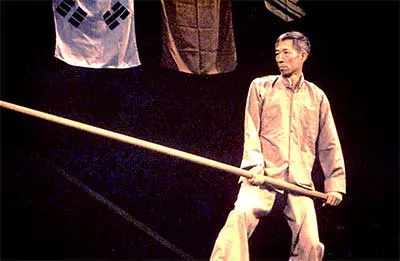
The most dramatic example of this for me was pole rotation.
Everyone talks about “using the waist.” That can become a trap. You lock the femurs. You twist the lumbar spine. You compensate with muscle.
For years I could not even get the pole off the ground without brute force. And even then it felt wrong.
The breakthrough came when I focused on releasing the femur heads and their surrounding ligaments. Especially the deep anterior hip ligaments. When they finally let go, it felt like defeating a final boss.
The pole did not move because I got stronger.
It moved because my skeleton organised itself differently.
Rotation began to transmit through the joint axis instead of being forced by muscle. The weight of the pole felt like it rotated itself. The structure carried it.
Do not misunderstand. It is nowhere near the level of Grandmaster Chu Shong Tin. But for me, simply lifting it cleanly without muscular strain was a revelation.
That shift did not come from strength training.
It came from releasing compression.
Ligaments Control More Than You Think
A single ligament can influence entire chains of muscle tone.
When you release a deep ligament, the nervous system interprets that as a global update. The joint is safe. Guarding is no longer required.
Multiple muscles switch off at once.
You did not stretch them.
You did not manually relax them.
You removed the reason they were bracing.
Most people attack muscle tension directly. They stretch, massage, force mobility.
But the root signal often lives deeper.
Release the ligamentous compression, and the muscular tension dissolves by itself.
Practical Approach
Forget tricks.
This is what actually works.
Feel for compression, not muscle tightness. Muscle tension is the symptom. Joint compression is the cause. The moment you sense surfaces pressing together, back off and search for space.
Use the laugh cue. Do not stretch the joint open. Invite it to release. Let it soften from the inside.
Track weight instead of chasing shapes. If the weight gets stuck, you have found the next joint that needs space.
Work upstream. If your hands feel stiff in the form, do not obsess over the wrists. Check your hips. Check your sacrum. Check your femur heads. Most limb tension begins at the base.
The Real Point
Power, fluidity and internal peace are not created by adding effort.
They emerge when compression dissolves.
When joints laugh, weight flows.
When weight flows, structure organises.
And when structure organises, everything becomes lighter, calmer and more powerful at the same time.